

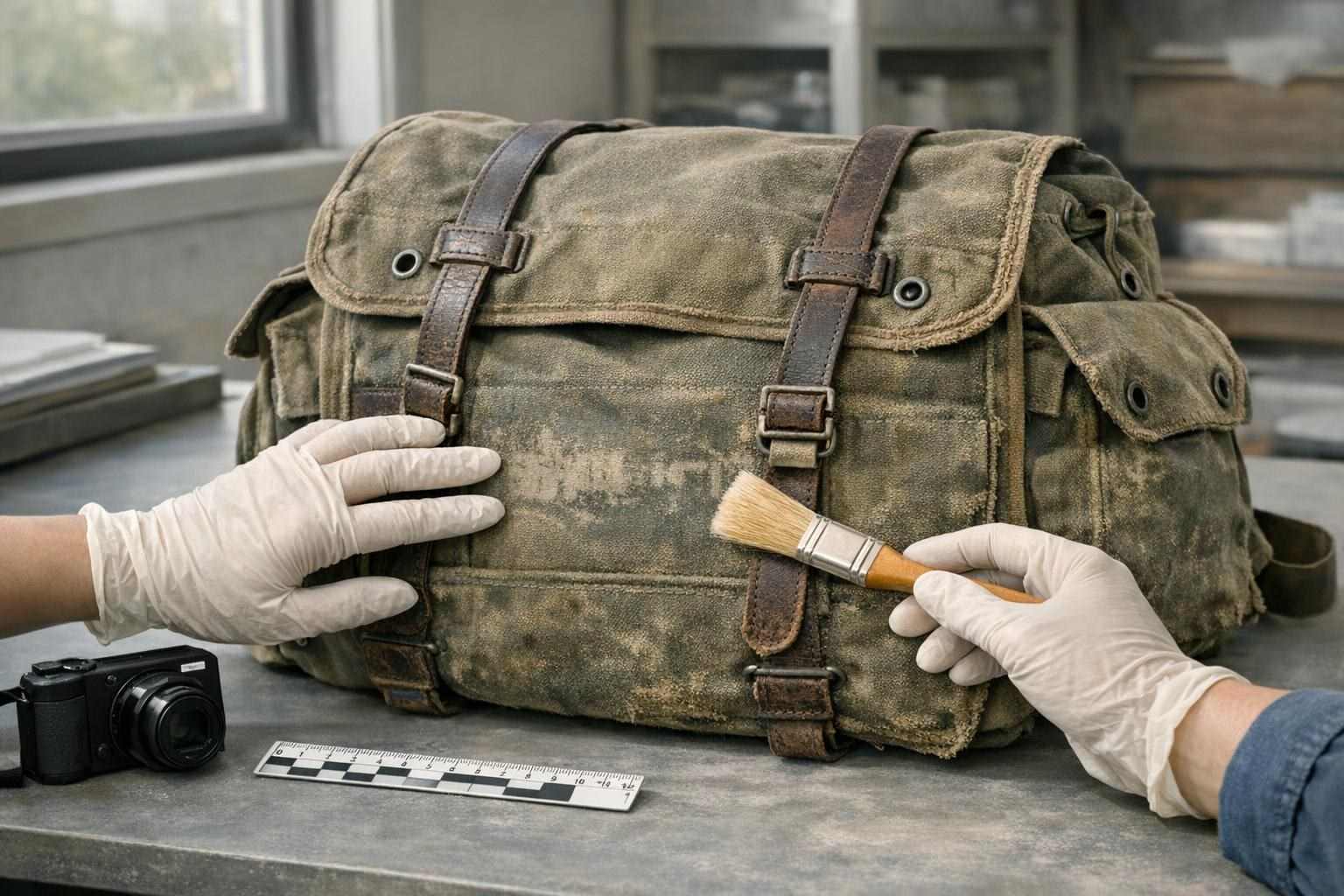
A stamped marking can give evidence of a coded object but does not have to prove who carried it, where it was used or who owned it before. Captions must therefore stick to the visible data from the frame and the related data from the other records and do not present any information as proven that has not been established in this way.
This gives military photography a useful discipline. A helmet, a field pack, some Insignia, a map case, some torn vehicle panels etc. can all be described by separating out the visible from the rest of it. And this can be done without producing a dull caption.
Start with the evidence the frame can actually show
Start with the evidence the frame can actually show. That means first listing all of the shape, material, color, fasteners, stitches, surface wear, printed text, painted marks and damage that the photograph actually shows. Use the simple word for each for the first part of the description, and add in the measured description for the rest.
Captions depend on the photographs that they describe. That means that they are limited by the same restrictions that the photographs are limited by. Thus, a caption for a frontal view of an object does not assert that reverse sides, interior linings, or methods of attachment of various components are or are not visible. Instead, the caption is restricted to description of what is visible on the exterior of the object as it was photographed. Thus, the caption might read: "Visible on exterior as photographed" or simply "As photographed" or "The image does not show".
When an object is stamped with a number, it is generally safe to report what you can read from the photograph. However, when part of a marking is not visible, it is best to say that it is not visible in the image. A carefully qualified observation is far better than an assumed transcription of an unclear marking that can later be found to be incorrect.
Treat identification as a claim, not a visual reflex
Many of the artifacts from different armies, services and time frames have similar shapes, cuts, colors, fastenings and emblems. Some of these may have been made by the same manufacturers, while others may have been issued by different services. Thus, an object of familiar form does not necessarily mean that the object in question was issued to a particular service.
Many objects appear to resemble other items so much that it is necessary to state the levels of certainty that have been reached in describing them. These could be "Appears to be…", "Identified in the collection record as…", "The visible features are consistent with…".
Note that this object resembles a utility pouch, but the image does not reveal any interior label or attachment points. Because of this, the identification to this type of object remains provisional until further research has established the internal features of this item.
Keep provenance separate from appearance
Provenance and the appearance of an object are two quite separate things. Provenance refers to where an object has come from, and how the history of that object has been recorded. Its appearance is what can be seen.
The collection records and/or accompanying note for this item attribute its origin to . (e.g. "Collection records attribute this item to", "The accompanying note identifies this item as") Such attributed information is to be treated with the same degree of skepticism as the information supplied in the original caption.
The distinction is one which it is important to draw in relation to quite different subjects. For example, whilst the fabric, stitching and patches on a service jacket can be described from a photograph of it, information about the wearer of a jacket and a full description of the written accounts of a family about how a jacket was kept are to be found in a catalog record and in the family accounts respectively.
Use one physical constraint to compare unlike objects
One physical constraint to use to compare like with unlike would be to use the same physical limitation that the object under discussion itself uses as evidence to tell history. So for example a metal plate with stamped characters on it can tell you what the characters said when the plate was new but not what the paint on it said when it was new. A piece of cloth can tell you about the construction of the item it is from and the way it was repaired but not about any written labels that may have been on it when new. A piece of paper can tell you about dates and signatures on it but not about the full text of written articles on it.
Remember, the physical evidence left behind is what connects all these different systems and time periods together. Follow the evidence of what survived on the object, rather than forcing it into a larger historical story.
Rather, write out the comparison in terms of the evidence you have to the comparison. So, for example, instead of saying "The plate shows a clear serial number. The fabric has good construction details but no labels," you're avoiding writing out a larger historical narrative and instead simply comparing the artifacts' physical remains. The evidence becomes the thread with which to compare apparently unrelated objects.
Describe wear without assigning a cause
Damage and wear are highly visualized items and thus very easy to misinterpret. A torn seam could have caused by use, by storage, by handling after the collection, or by intentional destruction. A piece of rust could have been caused by moisture after the item was made, by being left outside in the rain, by being left in a damp basement, etc. Thus each puncture-like hole, scorch, etc. should be described before any attempt at explaining it.
Therefore instead of saying that the item was damaged in combat in a huge pulp of blood by a sharp splinter of shrapnel, write a puncture is visible near the lower edge of the photograph. Instead of saying the fastener had failed in the field and left these darkened staining around it, write darkened staining appears around the fastener in the image.
It is also important to note that scenes shot outdoors are more prone to surface flaws due to intense light, mud, grime, and dark shadows. Make sure to describe what you actually saw in the image and not let the atmosphere and setting of the shot sway you in the wrong direction to interpret it for what it appears to be.
Build captions in layers readers can audit
When cataloging a collection for historical value it is best to build up a caption to a useful size in four parts: identification, description of visible features, description of documented features and unknowns. And that you should develop these four layers in a specific order.
A simple example of this kind of organized caption writing would be: "Canvas shoulder bag, identified in the collection records as a service item, the exterior of the bag showing two stitched compartments, faded mark and worn abraision on lower seam. The photographed view does not provide proof of original owner or date of issue."
It is best to treat photographs of historical events in a similar manner to other historical artifacts. In a caption to a photo of historical scenes it is best to identify what you can see, report any date or place information supplied with the photo as having come from a collection record or other documentation, and indicate what remains a mystery to you. Avoid turning the posture of individuals, the position of vehicles, and the presence of buildings in the background into evidence of intentions that you can't be sure you've read correctly.
Captions don't have to remove interpretation from visual storytelling, they simply need to label it. The reader needs to know what you have observed on the image, what has been documented about the image and what you have inferred from the combination of the two.