

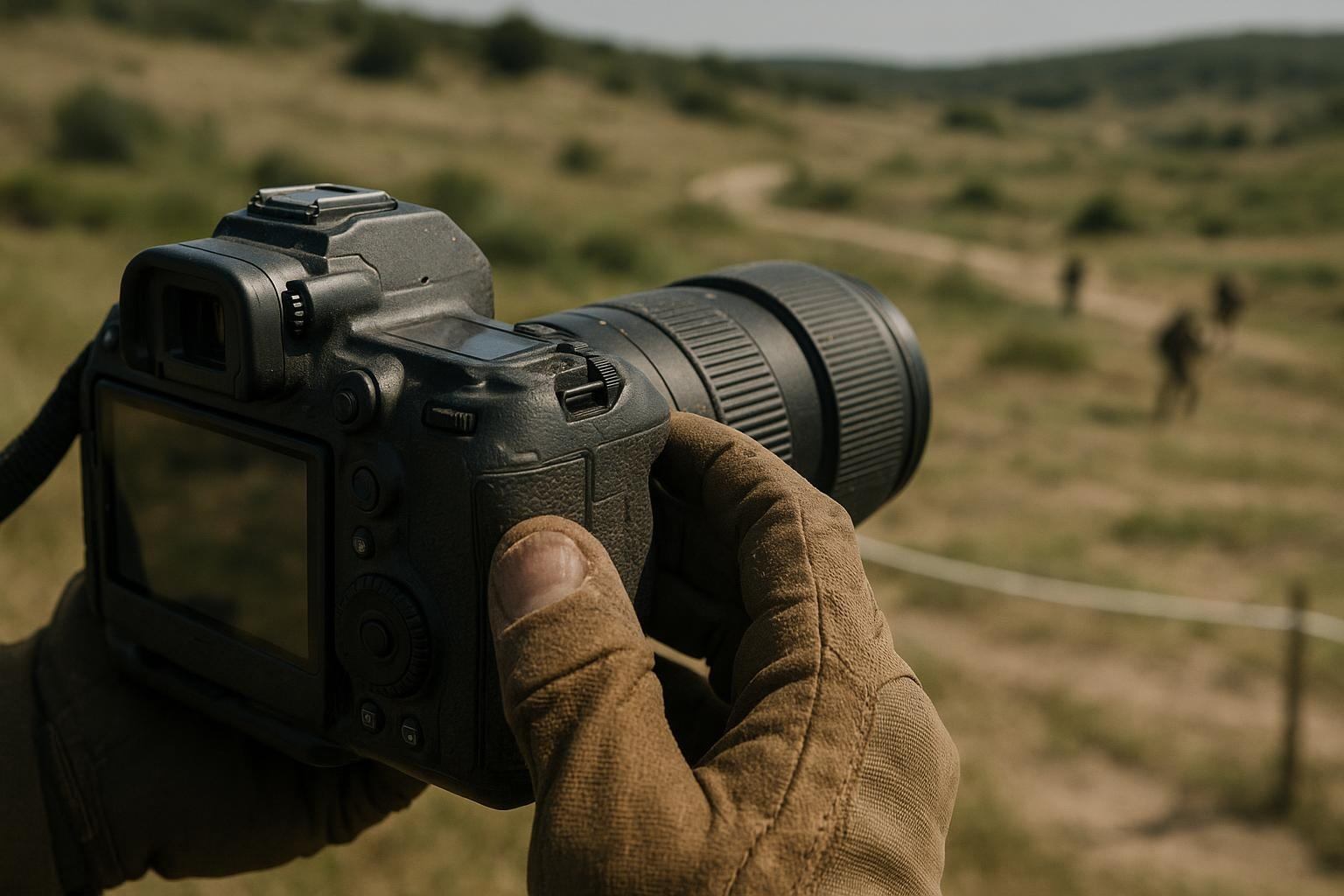
The overlooked preparation detail in outdoor action photography is deciding how far away you need to remain before raising the camera. That distance may be set by a public boundary, a guide's instruction, difficult terrain or respect for people under pressure. It also shapes your lens, shutter speed, composition, timing and caption.
Distance is both a physical constraint and an editorial choice. It determines which details are available and which must remain unknown. A close frame can describe equipment, expression or movement; a wider position can explain place, scale and consequence. Strong documentary work knows when each view is justified.
Start with a distance rule
Before considering camera settings, identify the limits of your position. Stay behind marked barriers, clear of active routes and follow instructions from event organisers, site staff or emergency personnel. Access rules vary and can change, so check current official guidance where you are photographing.
This is more than a safety precaution. A fixed distance gives the assignment visual discipline. Instead of drifting closer whenever the subject seems less dramatic, ask what your position reveals. Does it show the relationship between people and terrain? Does it conceal a vulnerable face? Does it keep an exit route clear?
For military photography, the rule also has an ethical dimension. Training, ceremonies, historical displays and public demonstrations may contain sensitive details even when spectators can access them. Avoid restricted material, personal documents, unguarded screens and identifiable people in distress. If a frame would expose a private moment without adding meaningful understanding, leave it out.
Let distance shape lens choice
A long lens is not automatically the best tool for action. It compresses space and can make separate elements appear dangerously close, while a wide lens exaggerates the distance between foreground and background. Both effects can be useful, but neither is neutral.
Choose the focal length according to the relationship you need to show. Use a longer lens when the subject must be isolated from a busy background or when moving closer would be unsafe or intrusive. Use a normal or wide view when the ground, weather, vehicles, spectators or built environment carry part of the story. Ask not, "How close can I make this look?" but, "What must remain visible for the image to be honest?"
Leave working room for movement. A subject running, turning or carrying equipment needs space in the direction of travel. A frame tight on every side may show effort while losing intention, route and destination.
Keep motion readable at the edge of the frame
Action becomes harder to interpret when distance removes small visual cues. From a remote viewpoint, a person may occupy little of the frame, so posture, shadow and surrounding lines must do more work. At closer range, hands, feet and changes in balance can explain an action that a face alone cannot.
Shutter speed should follow the movement you need to describe. A faster setting can isolate a decisive instant; a slower one can retain direction through blur. Neither is universally correct. If the purpose is to show a precise technical action, prioritise clarity. If it is to convey speed, weather or exertion, some blur may be more expressive.
Set focus for the way distance changes. Continuous autofocus can help when a subject approaches or crosses the frame, but it may follow a foreground object instead. A fixed focus point, pre-focused zone or manual focus can be more predictable when the route is known and the background is complex. Test it before the important sequence.
Build the wider story with scale
A dramatic frame can suggest an event without explaining it. Scale supplies the missing evidence. Include a horizon, line of vehicles, training area, crowd, doorway or stretch of weather-affected ground when it clarifies what the subject is doing and where the action sits.
In documentary work, a useful background may be busy because it contains information. Look for relationships rather than decoration: a figure dwarfed by a landscape, a small group separated by empty ground, or a repeated line leading from an object to the person using it.
Work in sequences as well as individual frames. A wide establishing image can be followed by a medium view and then a detail, but only if each adds something different. Repeated close-ups of equipment rarely create a wider story; a change in distance, direction or human response usually does more.
Treat military subjects as people, not symbols
Military imagery carries visual shorthand: uniforms, formations, vehicles and controlled gestures. These elements make a frame immediately legible but can also flatten its subject into an emblem. Ethical photography keeps attention on people, circumstances and consent where possible.
A public appearance does not mean unlimited permission to publish every image. Be especially cautious with minors, bereaved families, injured people and anyone whose vulnerability is central to the photograph. Avoid captions that claim motives or emotions you cannot verify. Describe what is visible, identify the setting accurately and separate observation from interpretation.
With historical material, distinguish archival fact from reenactment, display and modern interpretation. A convincing uniform or restored vehicle does not establish the full historical context. Captions should help viewers understand what they are seeing rather than manufacture certainty.
Use one field check before pressing the shutter
A short check can keep distance from becoming an afterthought:
– Position: Am I within a permitted and respectful viewing area?
– Purpose: Does this frame show action, context or a necessary detail?
– Space: Is there room for movement and a clear sense of scale?
– Settings: Are shutter speed, focus and exposure suited to the movement and light?
– People: Does the image expose private information, distress or unnecessary vulnerability?
– Sequence: Will it add something the previous frame cannot?
The wider story is not always the widest frame. Sometimes a detail is the most truthful record of a larger event; sometimes a tight crop removes the evidence that gives an action meaning. Distance helps decide between them. Treat it as a constraint to work with, not a problem to defeat, and your images can retain both immediacy and accountability.